Samuel RothAerospace engineering

SYRACUSE UNIVERSITY · CLASS OF 2027

Hi, I'm Sam.

I'm an aerospace engineering senior at Syracuse University, working in avionics at Lockheed Martin.

My experience spans avionics integration, model-based systems engineering, aerodynamic analysis, and thermal modeling. I’m also working on a Lockheed Martin-sponsored heat-transfer capstone.

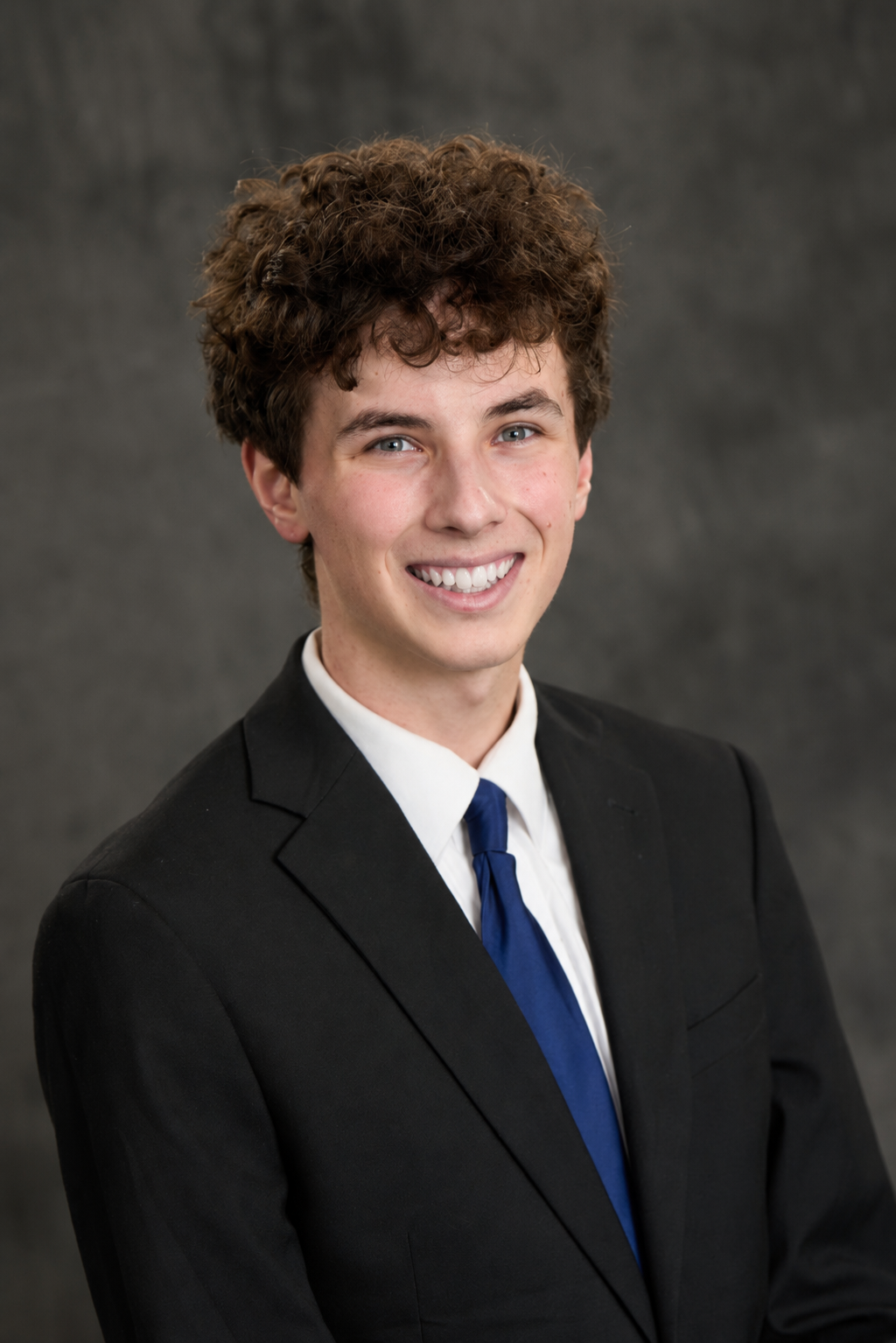
Samuel Roth smiling, wearing a suit and blue tie
Samuel Roth Student, Syracuse University

01 / CURRENT WORK

What I’m working on.

My current work includes avionics at Lockheed Martin, a sponsored heat-transfer capstone, and rocket test instrumentation with ORBiT.

ONGOING INTERNSHIP · MAY 2026–PRESENT

Avionics Engineering Intern

Lockheed Martin RMS · Sikorsky / Stratford, CT

Supporting avionics system development and model-based systems engineering during a continuing part-time internship.

At Lockheed Martin RMS / Sikorsky, I support avionics system development using Cameo Systems Modeler while completing my senior year at Syracuse.

During my summer internship, I reviewed electrical schematics, wiring diagrams, and cable assemblies against engineering and manufacturing requirements to support avionics integration and production. I also contributed to production process improvements.

Explore the first-place intern team project ↗
CURRENT · SPONSORED SENIOR CAPSTONE

Heat Transfer Capstone

Syracuse University · Lockheed Martin Syracuse

Working on a Lockheed Martin-sponsored heat-transfer project through Syracuse's senior capstone program.

I am part of a mechanical engineering capstone team addressing a heat-transfer problem sponsored by Lockheed Martin Syracuse.

The project extends my work in thermal analysis to a sponsor-defined engineering problem.

About the Syracuse capstone program ↗
01

Rocket test instrumentation

I work on a microcontroller-based thermocouple data acquisition system for ORBiT's propulsion test stand, integrating sensors and circuitry for experimental nozzle testing.

I recently earned my Tripoli Level 1 (L1) high-power rocketry certification with ORBiT.

ORBiT
Syracuse Rocketry
Earlier experience in community leadership & teaching

AUG 2024–MAY 2026

Resident Advisor

Engineering Living Learning Community · Syracuse University

Supported 38 residents through community programming, academic support, conflict resolution, and on-call crisis response.

MAY–AUG 2025

Aviation Camp Instructor

Hiller Aviation Institute / San Carlos, CA

Taught aviation fundamentals and STEM concepts to students ages 7–12 through hands-on activities and educational field trips.

EDUCATION

Syracuse University

B.S. Aerospace Engineering · Minor in Engineering Management

Expected May 2027 · GPA 3.7

02 / SELECTED PROJECTS

From a model to a result.

Research abroad, computational aerodynamics, structural design, and experimental testing, with the work behind each result.

RESEARCH ABROAD / UNIVERSITY COLLEGE DUBLIN

Why Not Blender?

Exploring whether animation software can make airflow modeling more accessible in engineering education.

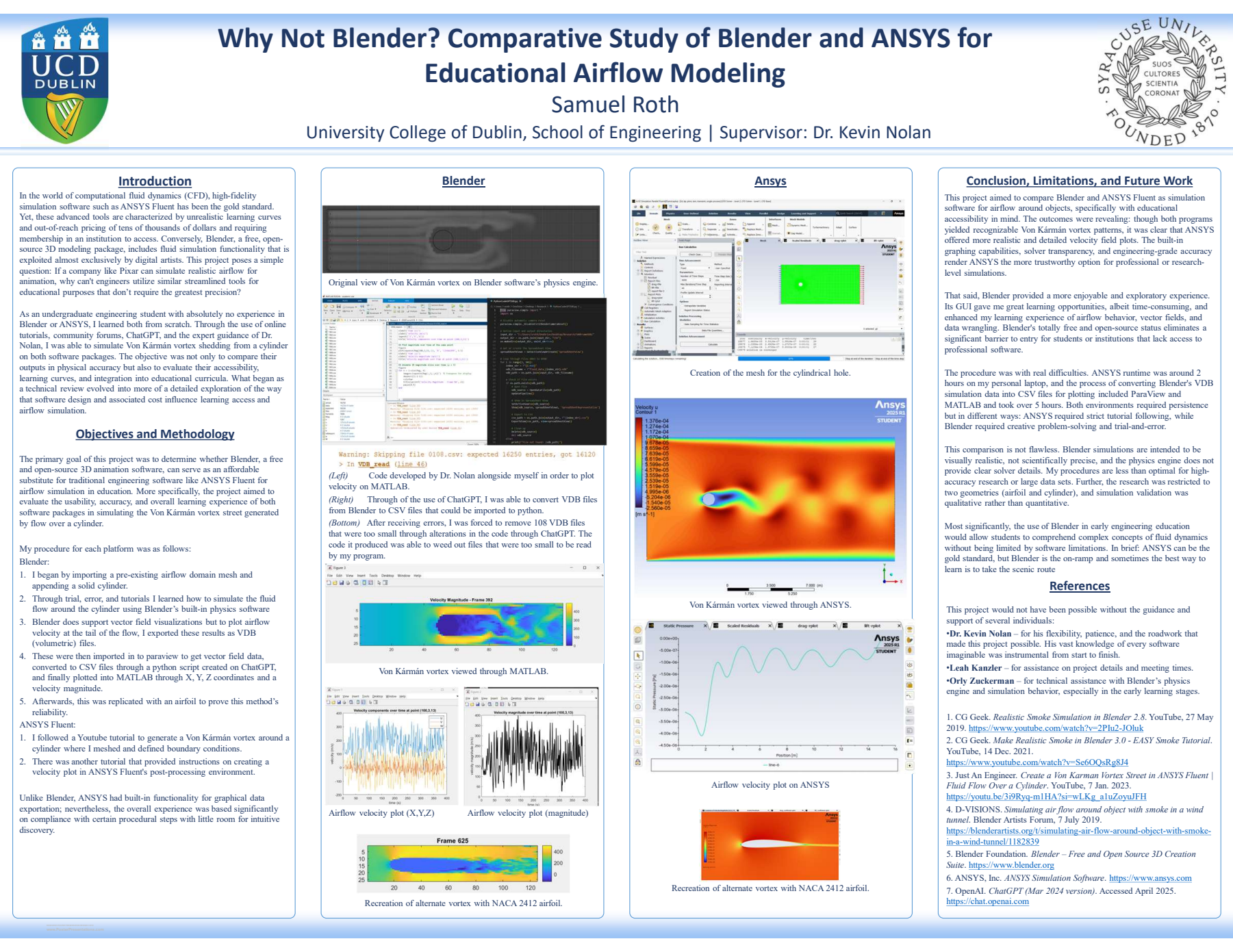
Research poster comparing Blender and Ansys Fluent, with simulation images and velocity plots
My research poster · Supervised by Dr. Kevin Nolan

THE QUESTION

Could Blender offer a useful starting point for students learning about airflow? During my study abroad in Dublin, I explored that question by comparing its simulation workflow with Ansys Fluent.

MY WORK

I learned both tools, simulated flow around a cylinder and a NACA 2412 airfoil, and worked through a data-export workflow using ParaView, Python, and MATLAB. Dr. Kevin Nolan guided the research and collaborated on the MATLAB plotting code.

A study of accessibility, learning, and simulation limitations.

What I learned

Both workflows produced recognizable vortex patterns. Blender offered an exploratory learning experience, while Fluent provided a more direct engineering analysis workflow. Moving Blender's volumetric data into usable velocity plots required substantial troubleshooting.

The comparison was qualitative and limited to two geometries. It did not establish numerical accuracy or validate Blender as a substitute for engineering CFD. The poster documents tutorial-based learning and AI-assisted scripting alongside supervisor support.

01 / COMPUTATIONAL AERODYNAMICS · SPRING 2026

Building a model that predicts lift.

From source-only flow to a lifting NACA 4412 airfoil, with a point vortex and the Kutta condition.

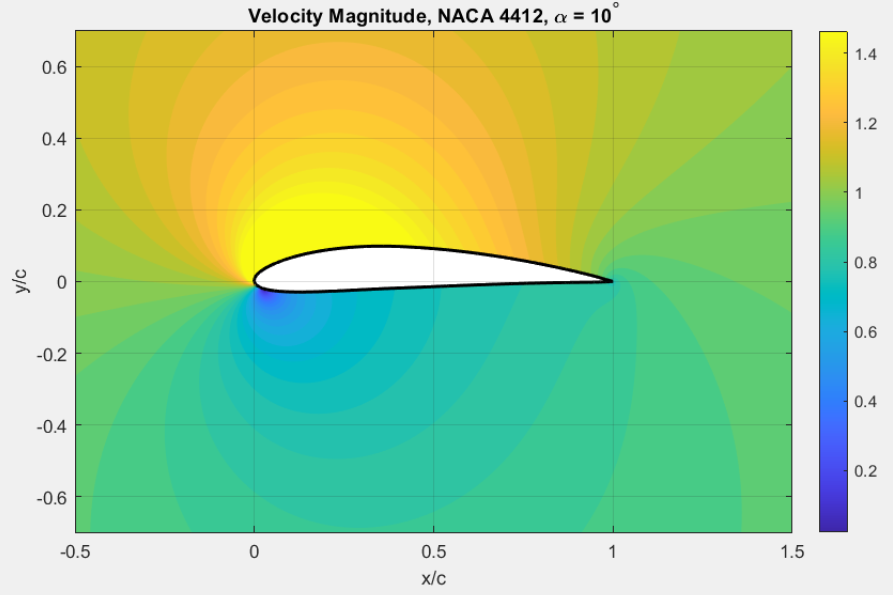
Velocity magnitude contours around the NACA 4412 airfoil at 10 degrees angle of attack
Velocity contours at 10° angle of attack · Project 3, PDF page 8

MY WORK

I extended a MATLAB source-panel model to include circulation, then compared pressure distributions and lift predictions with thin airfoil theory and XFOIL.

6.5% difference from inviscid XFOIL lift at 10°

That comparison applies to one inviscid case. The model does not capture viscous drag, flow separation, or stall.

How the work developed

The first report examines a source-only NACA 0012 model and its limitations at nonzero angles of attack. The second adds circulation for a NACA 4412 airfoil and evaluates 0°, 10°, and 20° cases. At 10°, the computed lift coefficient is 1.71429 versus 1.83376 for inviscid XFOIL.

FINITE ELEMENT ANALYSIS / THERMAL · STRUCTURAL · MODAL

Heat, rotation, and a cooling fan.

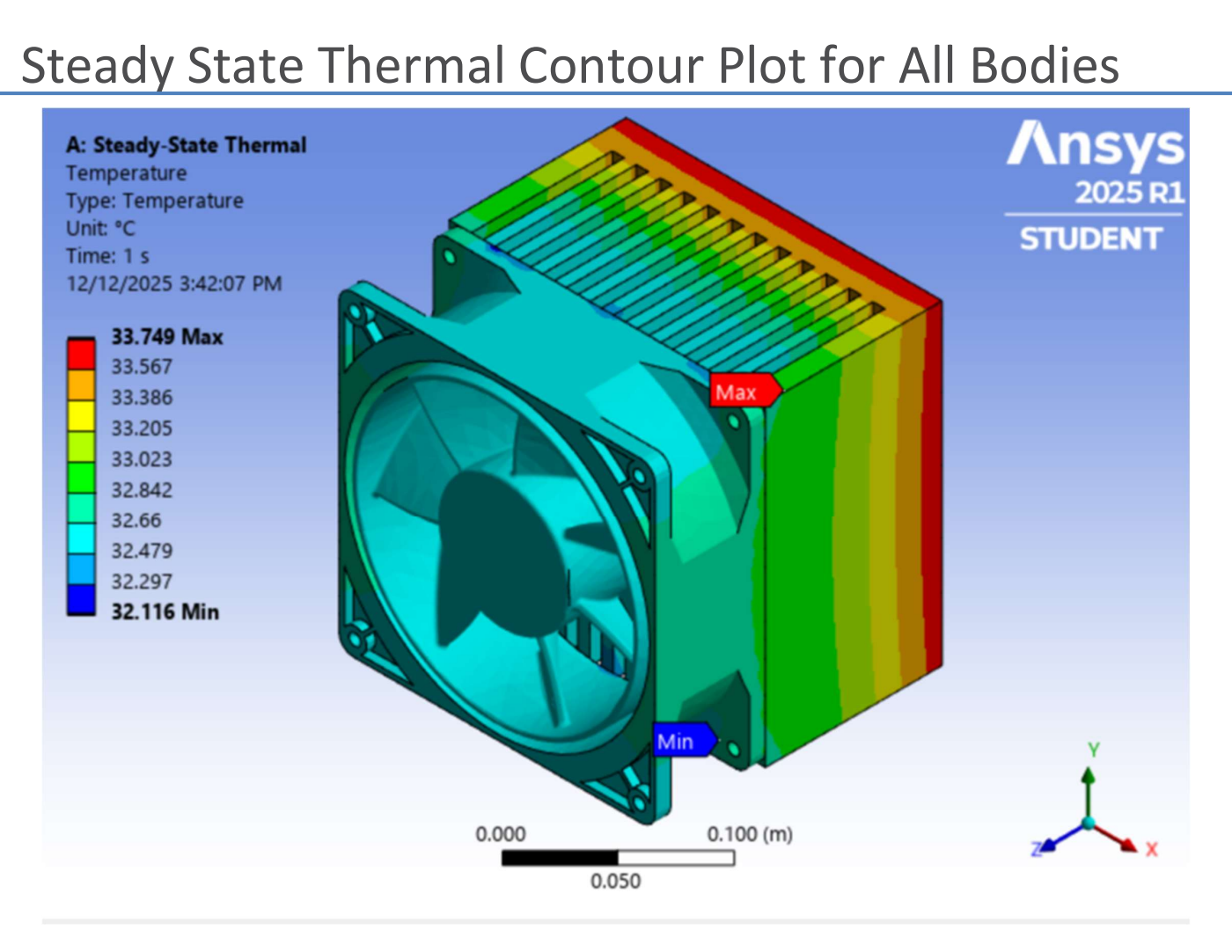
An Ansys study of how a CPU cooling assembly responds to thermal and rotational loads.

Ansys steady-state temperature contour of a CPU heat sink, fan, and casing
Steady-state thermal results · Presentation, PDF page 8

THE ANALYSIS

I studied an aluminum heat sink, a glass-filled nylon fan, and a plastic casing using steady-state thermal and structural analyses. A separate one-seventh fan-sector model explored the effect of rotational speed, followed by a full-fan modal analysis.

One assembly, three perspectives: heat flow, mechanical response, and vibration.

Loads, methods, and findings

The baseline model applies a 2,000 W/m² heat flux, convection to air at 28°C with a coefficient of 30 W/m²·°C, and a fan speed of 5,000 RPM. The study examines temperature, equivalent stress, deformation, and safety factor.

The speed study shows increasing stress and deformation as centrifugal loading grows with the square of rotational speed. The modal analysis examines the first six natural frequencies and mode shapes.

These are simulation results under specified model assumptions. Mesh size was constrained by a student license; physical testing, mesh-convergence evidence, and confirmed fan-tip clearance would be needed to support an operating-limit claim.

02 / AIRCRAFT STRUCTURES · SPRING 2026

Sizing an aircraft wing spar.

I evaluated a 120-inch spar at 11 spanwise stations, checking strength, yielding, crippling, local buckling, and fatigue. The report also estimates weight and tip deflection.

1.551Reported governing factor of safety
Crippling at the root
Approach and findings

The analysis identifies the governing maneuver load, sizes the cross-section along the span, and integrates the area distribution to estimate a 56.172 lb spar weight. Euler–Bernoulli beam calculations give a 5.474 in tip deflection under the report's design load.

These are analytical course-project results under the report's stated loading and material assumptions.

03 / COMPRESSIBLE FLOW · SPRING 2026

Checking a Mach 2 wind tunnel.

My lab report compares pressure-based Mach estimates with an independent estimate from Schlieren shock imaging, using MATLAB for data analysis and uncertainty propagation.

1.96–2.13Approximate Mach estimates
Across pressure and optical methods
Approach and findings

Isentropic pressure methods give Mach numbers near 1.98, the Rayleigh Pitot method gives approximately 1.96, and the oblique-shock method gives approximately 2.13.

The report examines shock-angle measurement sensitivity and the limited steady-flow interval of a blow-down tunnel. Only one run per configuration was available, limiting repeatability assessment.

MORE EXPERIENCE

04

Wind Tunnel Aerodynamic Laboratory

A group laboratory covering tunnel calibration, vortex shedding, wake drag, boundary layers, airfoil performance, and finite-cylinder flow. My report brings the experimental results together with aerodynamic theory and MATLAB analysis.

Experimental testing
Data analysis
05

Hybrid-electric propulsion

I contributed Ansys Mechanical thermal analysis to a hybrid-electric drone propulsion concept developed by a five-person team during my Sikorsky internship. The competition offered thermal analysis as an optional deliverable, which our team chose to include to strengthen our submission.

Our five-person team placed first among 10 teams in the Sikorsky intern competition.

Sikorsky
Intern competition

03 / A LITTLE ABOUT ME

It started with
looking up.

I grew up in Foster City, California, beneath the landing path into San Francisco International Airport. Planes were loud enough to pause a conversation, so I would look up and try to work out the aircraft type or airline passing overhead. Those interruptions became something to be curious about. Attending flight camp when I was young gave that curiosity another place to grow, and eventually it led me to aerospace engineering at Syracuse University.

These days, I share that interest with other students through our AIAA chapter, where I serve as president, and ORBiT, our rocketry club, where I'm treasurer and secretary. I've attended two AIAA SciTech conferences and studied abroad in Dublin. Away from engineering, I can happily spend hours exploring maps, flags, and the geography of countries around the world. I also enjoy caving, backpacking, and mountain biking when I get the chance.

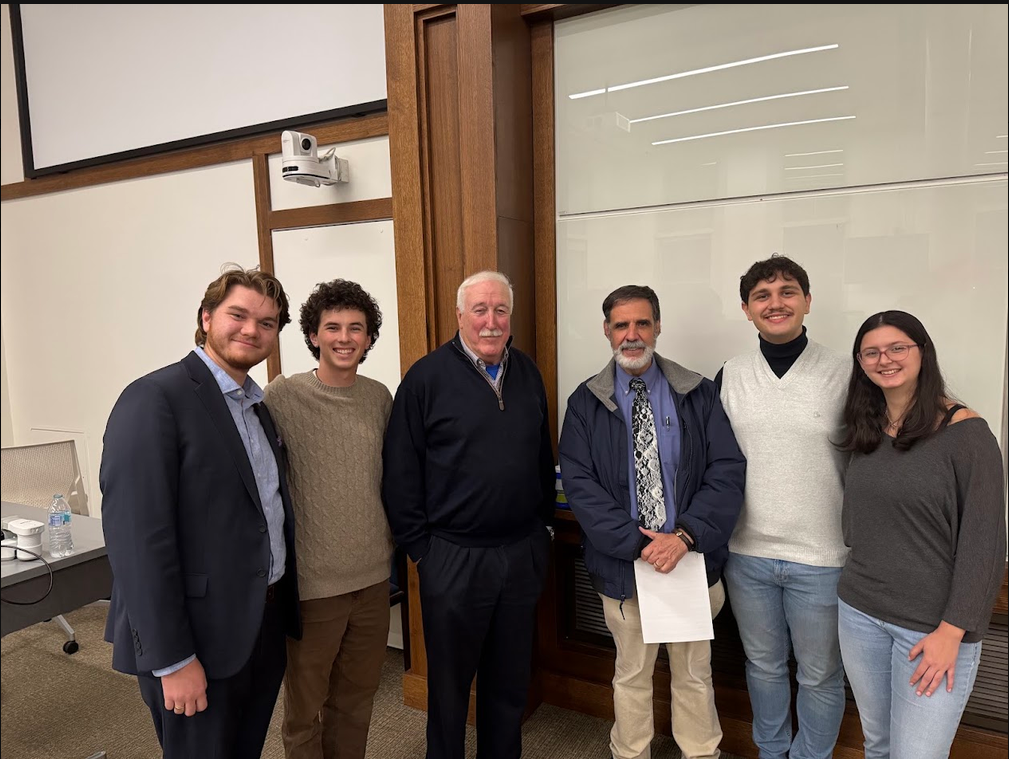
Sam with the Syracuse AIAA board, a faculty professor, and Sean O’Keefe at an AIAA guest talk
With the AIAA board, our faculty professor, and former NASA Administrator Sean O’Keefe.

BRINGING PEOPLE TOGETHER

AIAA at Syracuse

As president of Syracuse's AIAA chapter, I help connect students with the aerospace community. I helped organize a guest talk with former NASA Administrator Sean O’Keefe, bringing students together for a conversation with an aerospace leader.

About Sean O’Keefe · NASA ↗

04 / KEEP IN TOUCH

Let's connect.

I'm open to connecting about interesting engineering opportunities for 2027, projects, or shared aerospace interests.